

















BCM Arya School Lalton

bcmlalton@gmail.com

+91 62845 56494 | +91 76966 56428

ॐ भूर् भुवः स्वः। तत् सवितुर्वरेण्यं। भर्गो देवस्य धीमहि। धियो यो नः प्रचोदयात् ॥
Call Us

+91 62845 56494
+91 76966 56428

Mail Us

bcmlalton@gmail.com

Categories
Principal's Blog

Exam Stress Management

Principal Blog

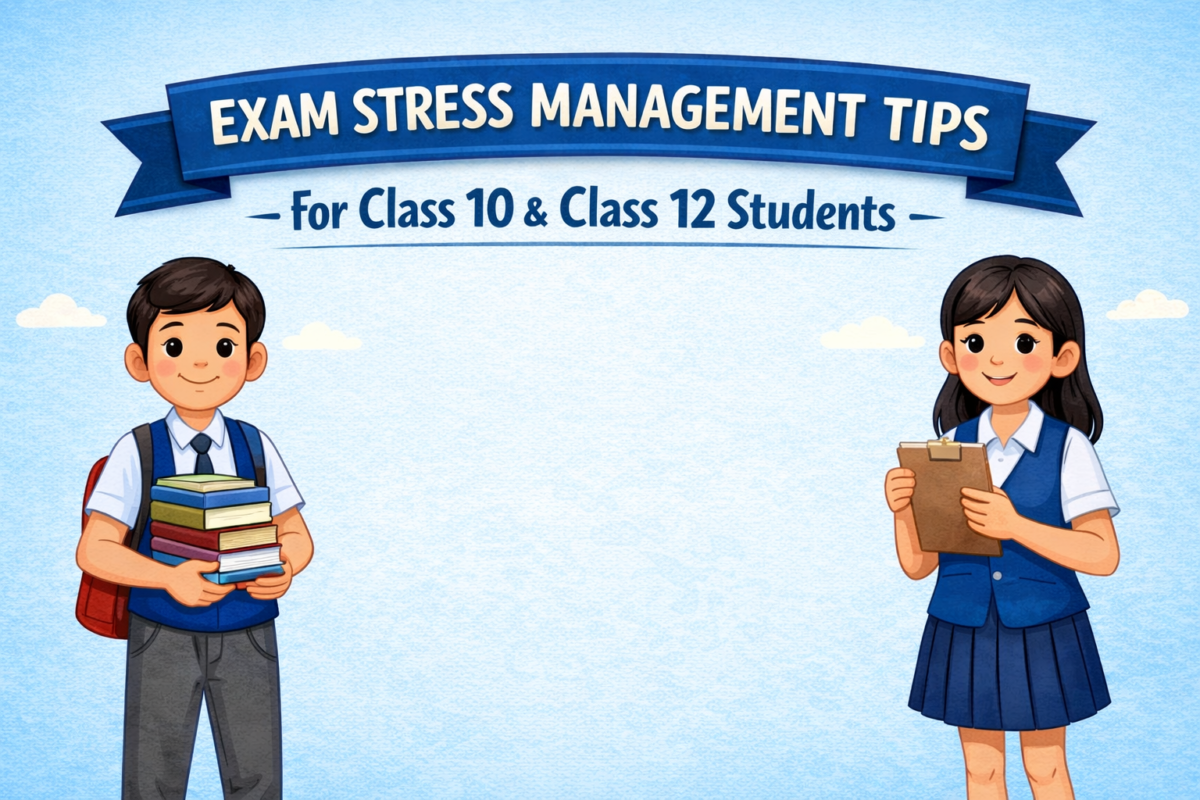
Exam Stress Management for Class 10 & 12 Board Students

Mrs. Kritika Seth

Board exams in Class 10 and Class 12 are major academic milestones. Feeling nervous or stressed is completely normal—but unmanaged stress can affect performance. This guide is designed specifically to help Class 10 and 12 students stay calm, focused, and confident during exam preparation.

 Exam Stress Management Tips for Class 10 Students

Class 10 board exams are often a student’s first major public examination, which makes them emotionally challenging.

 1. Understand That This Is a Beginning, Not an End

Class 10 results help shape academic choices, but they do *not* decide your entire future. Many successful people did not score “perfect” marks.

👉 Focus on learning concepts, not just marks.

2. Create a Simple, Realistic Study Plan

Avoid overloading your schedule.

* Study 5–6 subjects daily in short sessions
* Keep time for revision and practice papers
* Include breaks for rest and relaxation

A flexible plan reduces pressure and improves consistency.

3. Reduce Fear of New Subjects

Subjects like Mathematics and Science often cause anxiety.

* Practice step-by-step problem solving
* Revise formulas daily
* Ask doubts early—don’t postpone confusion

Confidence grows with practice.

4. Limit Screen Time

Excessive mobile or social media use increases anxiety and distraction.

* Set fixed screen-free study hours
* Use devices only for educational purposes

5. Take Care of Your Routine

* Sleep at least 7–8 hours
* Eat balanced meals
* Stay hydrated

A healthy routine keeps the mind alert and calm.

Exam Stress Management Tips for Class 12 Students

Class 12 exams come with higher expectations and future-related pressure (college, entrance exams, career decisions).


1. Separate Board Exams from Career Pressure

Boards are important, but they are *one step*, not the final destination.

* Many entrance exams, colleges, and career paths exist
* One exam cannot define your potential

2. Focus on Conceptual Clarity

Class 12 subjects require deeper understanding.

* Revise key concepts regularly
* Practice previous years’ question papers
* Work on time management during writing practice

3. Manage Overthinking and Burnout

Long study hours without breaks increase stress.

* Use 50-minute study sessions
* Take short mental breaks
* Avoid studying late into the night daily

Burnout reduces productivity, not improves it.

4. Avoid Comparison and Competition Stress

Comparing mock scores or preparation levels only increases anxiety.

* Track your own improvement
* Focus on weak areas instead of others’ strengths

Progress matters more than ranking.

5. Talk About Your Stress

Academic pressure is heavier in Class 12.

* Share concerns with parents or teachers
* Seek guidance instead of struggling silently

Asking for help is a strength, not a weakness.

Exam-Day Stress Management Tips (For Both Classes)

* Wake up early and eat light, healthy food
* Reach the exam center on time
* Take deep breaths before reading the question paper
* Start with questions you know well

A calm start sets the tone for the entire exam.

Final Message for Class 10 & 12 Students

Your hard work matters more than your fear. Board exams test preparation—not intelligence, talent, or future success. Stay consistent, trust your efforts, and remember: *this phase will pass, but the skills you build now will stay with you for life*.

Categories
Principal's Blog

Panchaadi-Five-Step Learning Process

Principal Blog

Panchaadi-Five-Step Learning Process

Mrs. Kritika Seth

Panchaadi – Five-Step Learning Process

The five-step learning process – ‘Panchaadi’ – is a good guide to formulating the sequence that a Teacher may adopt in planning for instruction. This process is also helpful for parents to understand how children learn in a structured and meaningful way.

Aditi (Introduction)

As a first step, the Teacher introduces a new concept/topic by establishing a connection with the child’s prior knowledge. Children gather relevant information regarding the new topic with the help of the Teacher by asking questions, exploring, and experimenting with ideas and material.

Bodh (Conceptual Understanding)

Children try to understand core concepts through play, enquiry, experiments, discussion, or reading in the second step. The Teacher observes the process and guides the children. The teaching plan has the list of concepts to be learnt by the children.

Abhyas (Practice)

The third step is about practice to strengthen understanding and skills through a range of interesting activities. Teachers can organize group work or small projects to reinforce conceptual understanding and attainment of competencies.

Prayog (Application)

The fourth step is about applying the acquired understanding in the child’s everyday life. This can be accomplished through various activities and small projects.

Prasar (Expansion)

The fifth step is about spreading the acquired understanding through conversations with friends, telling each other new stories, singing new songs, reading new books together and playing new games with each other. For each and every new topic learnt, a neural pathway is created in our brain. Sharing knowledge strengthens our learning. A neural pathway is incomplete if we don’t teach what we have learnt. Teaching makes learning clear and long-lasting.

Categories
Principal's Blog

Youth and Stress: Turning Pressure Into Power

Principal Blog

Youth and Stress: Turning Pressure Into Power

Mrs. Kritika Seth

Youth and Stress: Turning Pressure Into Power

In today’s fast-paced world, stress has become an almost unavoidable part of youth. Whether it’s the pressure to excel academically, social expectations, career uncertainties, or personal challenges, young people often find themselves navigating a maze of overwhelming emotions and demands. But here’s the truth: stress, while challenging, can also be a powerful catalyst for growth—if we learn to harness it.

 Understanding Stress: Not the Enemy, But a Teacher

Stress isn’t just a bad feeling or a burden; it’s a natural response designed to alert us to challenges and push us to act. When managed well, stress sharpens focus, fuels motivation, and builds resilience. The problem arises when stress feels constant, unmanageable, and isolating.

As youth, you are at a unique stage of life—a time full of potential, discovery, and transformation. It’s normal to feel overwhelmed at times. But remember, stress doesn’t define you. How you respond to it does.

The Power of Perspective: Change Your Story

Imagine stress as a fire: left unchecked, it can burn out of control, but with care, it can warm and light your path. Reframe stress as a sign that you care deeply about your goals and growth. This shift in mindset transforms stress from a threat into a challenge, a chance to prove your strength.

Ask yourself:

* What is this stress teaching me?
* How can I channel this energy into something positive?
* Who can I reach out to for support?

 Practical Steps to Build Your Resilience

1.Breathe and Pause: When anxiety rises, take a moment to breathe deeply. Simple breathing exercises reset your nervous system and bring clarity.
2.Set Realistic Goals: Break big tasks into manageable steps. Celebrate small wins—they add up.
3. Move Your Body: Exercise releases endorphins, the natural mood lifters. Even a 10-minute walk can shift your mindset.
4.Connect: Share your feelings with friends, family, or mentors. You’re not alone, and speaking up lightens the load.
5. Practice Self-Compassion: You’re human. It’s okay to stumble. Treat yourself with the kindness you’d offer a friend.
6.Limit Digital Overload: Social media can amplify stress and comparison. Set boundaries and take tech breaks.

Your Story Matters

Stress might knock you down, but it doesn’t have to keep you there. Every challenge you overcome adds to your story of resilience and courage. You are stronger than any obstacle. Embrace the struggle, learn from it, and use it to propel you forward.

Remember, greatness isn’t about never feeling stressed—it’s about rising every time you fall. The world needs your energy, your ideas, and your passion. Step into your power, because your best days are ahead.

Closing Thought:

“In the middle of difficulty lies opportunity.” — Albert Einstein

Youth is your springboard. Stress is just one part of your journey, not the destination. Face it boldly, grow from it fiercely, and watch yourself soar.

Categories
Principal's Blog

Mastery in Reading with Understanding – The Base of Learning

Principal Blog

Mastery in Reading with Understanding – The Base of Learning

Mrs. Kritika Seth

Reading is not just the act of moving our eyes across a page. True reading means understanding, analyzing, and applying the knowledge we gain.

For students, it is the foundation of learning in every subject – from science and mathematics to literature and history.

Why Reading with Understanding is Important

Foundation of All Learning
Every subject requires reading – whether it is a story in English, a word problem in mathematics, or an explanation of a scientific concept. Without proper reading skills, students miss the essence of what is taught.

Improves Comprehension & Memory
When students understand what they read, they remember it longer and can recall it more effectively during exams or real-life applications.

Boosts Critical Thinking
Reading deeply helps students analyze situations, compare ideas, and form opinions rather than just memorizing facts.

Enhances Communication Skills
A student who reads with understanding develops a richer vocabulary, better sentence structure, and clearer expression.

Builds Confidence in Learning
Mastery in reading allows students to approach new topics without fear. They feel confident in tackling difficult concepts because they know how to understand step by step.

Tips for Mastering Proper Reading with Understanding

Read Slowly and Carefully – Don’t rush through paragraphs. Pause, understand the meaning, and then move ahead.

Highlight Key Points – Underline or mark important words, definitions, or examples. This improves focus and recall.


Ask Questions While Reading – Stop and ask yourself: What does this mean? Why is this important? How does it connect to what I already know?

Break Down Difficult Words – If you don’t understand a word, break it into parts, check its meaning, and re-read the sentence.

Visualize the Content – Imagine what you are reading. For example, if it is a science experiment, picture it in your mind.

Summarize in Your Own Words – After reading a paragraph, close the book and explain it simply. If you can do this, you’ve understood it.

Use Reading Aloud – Reading aloud improves concentration, pronunciation, and retention.

Practice Regularly – Like any skill, reading improves with practice. Spend 20–30 minutes daily on focused reading.

Connect Reading to Real Life – Relating reading to your daily life makes it meaningful and memorable.

Create a Distraction-Free Zone – Read in a quiet place without mobile distractions so you can fully focus.

Final Thought

Reading with understanding is the gateway to knowledge. A student who masters this skill not only performs well in school but also develops a habit of lifelong learning. Remember:

“A reader today is a leader tomorrow.”

    Let's Connect

    Have questions? We are here to help you.